
Private Equity: The Billionaire's Playbook
You’ve heard the term thrown around in finance circles, maybe caught it in a headline about some massive corporate deal, or seen it mentioned when a beloved brand suddenly changes ownership.
Private Equity (PE). One of those finance terms that sounds mysterious, exclusive, and maybe a little intimidating… until someone explains it in plain English. Think of PE as big investors buying stakes in companies, improving them, and selling them later for a profit. That’s the core idea. Everything else fits around this.
Understanding how private equity works gives you a window into how this exclusive world of modern finance actually operates – even if you’re never going to invest a rupee in it yourself.
Private Equity 101: Let's Start Simple
Break down the name, and you’re halfway there:
Private means these investments aren’t traded on stock exchanges like the shares you might buy on the NSE or BSE. No ticker symbols, no real-time prices flashing on your screen.
Equity means ownership. Someone’s buying a stake – often the entire company.
Put them together: Private Equity refers to investments made in private companies (i.e., companies not listed on the stock market) or in publicly listed companies that investors plan to take private.
Private equity firms pool money from large investors – like pension funds, insurance companies, wealthy individuals, family offices, university endowments – and use that capital to buy a stake in the businesses. Once they buy the stake, they don’t just sit back. They actively help the business grow, become efficient, and increase profitability. Then they eventually exit (sell) the company at a higher valuation.
Who Invests in Private Equity?
PE firms usually raise money from institutional investors, such as:
- Pension funds (e.g., retirement funds)
- Sovereign wealth funds
- Insurance companies
- Banks
- Family offices
- High-net-worth individuals (HNWIs or HNIs)
They invest because PE historically offers higher returns compared to public markets – though it also comes with higher risk. Minimum investments are typically in the millions – often $1 Million or more, sometimes much more.
How Private Equity Actually Works
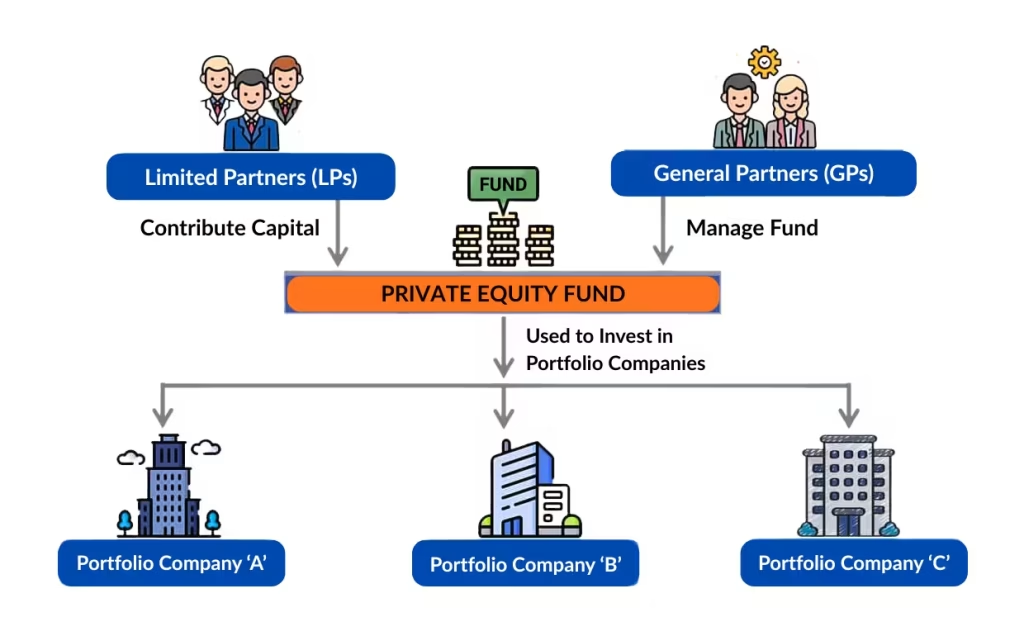
Think of a private equity firm as a specialized buyer and fixer of businesses. Here’s the basic PE playbook:
1. Raise the Fund: PE firms collect capital from big investors – pension funds, university endowments, insurance companies, ultra-wealthy individuals. These investors are called Limited Partners (LPs), and the fund they pool the money into is called a Private Equity Fund (PE Fund).
2. Identify & Buy Companies: The PE firm (called the General Partner or GP) uses this pool of money to acquire either controlling, majority, significant, or minority stakes in certain companies. The focus of PE firms is to capture some arbitrage or growth to maximize returns for their investors by increasing the profitability and value of these companies. So, the PE firm looks for companies that:
- Have huge growth potential
- Are undervalued
- Have strong potential but need improvement
- Are mismanaged
- Could grow in new markets
- Would benefit from cost restructuring or technology upgrades
The companies being managed? Those are called Portfolio Companies.
3. Make Improvements: This is where PE firms create real value. Over 3-7 years, they work to make these companies more valuable as they:
- Bring in better leadership
- Infuse funds/debts
- Cut unnecessary costs
- Expand product lines
- Improve operations
- Grow into new markets
- Digitize or modernize the company
Basically, they make the business healthier and more profitable.
4. Sell for Profit (Exit): After 4-7 years (average), once these portfolio companies are indeed healthier and profitable, PE firms sell them through:
- IPO (take it public)
- Sale to another company (strategic buyer)
- Sale to another PE fund (secondary buyout)
- Management buyout (existing team buys it)
5. Split the Winnings: Once the business is sold, profits are distributed among investors. Everyone gets a share of the profits. LPs receive their share based on the investments they made; GPs get 20% of the profit as carry.
Not All Private Equity Is Created Equal
Private equity isn’t a monolithic thing. There are several flavours, each with its own strategy:
Buyouts: The Heavyweight Championship
This is what most people think of when they hear “private equity”. Sometimes, PE firms buy established, mature companies outright. In case a PE fund uses debt to acquire a company, it is called a leveraged buyout (LBO), which is a fancy way of saying they use a lot of borrowed money to make the purchase. In India, classic LBOs by PE funds are relatively uncommon due to regulatory constraints on acquisition financing. As a result, many PE transactions rely more heavily on equity and structured financing solutions rather than traditional high-leverage buyout models.
Remember the book (and the movie) “Barbarians at the Gate: The Fall of RJR Nabisco”? That’s the classic LBO story – KKR’s acquisition of RJR Nabisco in the 1980s. Kohlberg Kravis Roberts & Co. (KKR) acquired the tobacco and food giant RJR Nabisco for about $25 billion, in a historic leveraged buyout. This was the largest LBO at the time and was financed with a substantial amount of debt, leading to significant debate and controversy. The deal was the subject of the book and the movie.

Today’s buyouts are often more sophisticated, but the principle remains the same: buy the whole company, control it completely, transform it.
Growth Equity: The Middle Path
Some companies don’t need a complete takeover – they just need capital to expand. Growth equity investors take minority stakes in mature companies that want to scale up – usually buying out the founder family’s stake and bring in professional managers to run the company. It’s less aggressive than a buyout, more collaborative.
Venture Capital (VC): The Startup Lottery
Technically a subset of PE, venture capital (VC) invests in early-stage and high-growth startups. Unlike traditional private equity, which focuses on established businesses, VC funds back companies at the idea, product, or early revenue stage.
VC investments typically involve minority ownership and are made across funding rounds such as Seed, Series A, Series B. These startups often operate in innovation-driven sectors like climate-tech, clean energy, fintech, and SaaS.
While venture capital carries higher risk due to early-stage uncertainty, successful startups can deliver outsized returns. Although venture capital differs in approach, it remains part of the broader private equity ecosystem, as both invest in private companies.
Distressed Investing: The Turnaround Artists
These PE firms hunt for struggling companies trading at fire-sale prices. They buy them cheap, restructure operations, fix what’s broken, and either revive them or strip them for parts. It’s sometimes called vulture investing, though practitioners prefer “special situations”.
Secondary Buyouts: The Hand-Off
Sometimes PE firms sell their portfolio companies to… other PE firms. Why? Maybe the seller has held it long enough and wants to cash out, while the buyer sees additional upside with a different strategy.
Show Me the Money: PE Returns and Fees
The Returns
PE firms target returns of 20-25% annually (measured as Internal Rate of Return or IRR). That’s significantly higher than public market averages. Of course, with higher returns come higher risks and much longer lock-up periods – your money’s tied up for a decade or more.
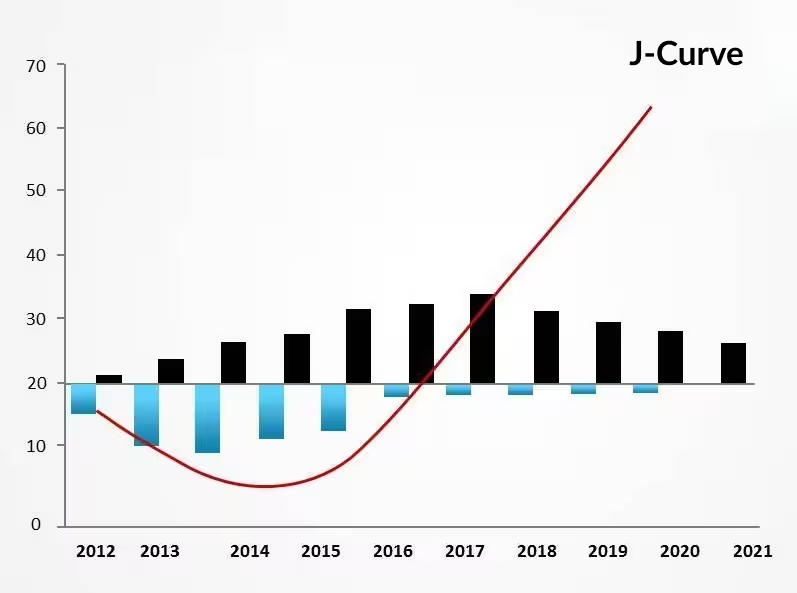
PE investments follow a typical J-curve pattern: initially, your investment value drops (you’re paying fees, deals take time to materialize), but eventually – if things go well – returns shoot upward dramatically. This “J” shape occurs because early years focus on expenses and deployment, while later years focus on generating gains, as shown in graphs of the fund’s performance over time.
The Fee Structure: “2 and 20”
Here’s why PE fund managers drive fancy cars:
- Management Fee: They receive 2% of committed capital annually, regardless of performance. On a ₹1,000 crore fund, that’s ₹20 crore per year. That’s quite substantial, but then the fee is not just for sourcing the deal but working the first 2-3 years to improve profitability, none of which comes easy.
- Carried Interest: They get 20% of profits above a certain threshold. If the fund makes ₹300 crore in profit, the PE firm keeps ₹60 crore.
However, the failure rate of PE deals is 70-80%. A mere 20-25% of portfolio companies make profits, usually out-sized returns compensating for the losses of other investments, and so overall, they do make money. Do the math over a 10-year fund, and you can see why PE firms can be incredibly lucrative for their founders.
The Dark Side: Let's Be Honest
Private equity has critics, and some criticism is deserved:
Job Cuts and “Restructuring”: When PE firms talk about “operational improvements”, it often includes layoffs. often invests in family-run businesses, bringing a more institutional and performance-driven approach. This typically involves reducing emotional decision-making and focusing on operational efficiency and profitability, which may sometimes include difficult restructuring decisions such as workforce rationalization. While sometimes necessary to save a failing business, it’s also where PE’s reputation gets tarnished.
Debt Overload: Remember that leverage we talked about? It cuts both ways. Load a company with too much debt, and it can collapse under the weight. Toys “R” Us is the cautionary tale – acquired in a massive LBO, loaded with debt, unable to invest in e-commerce to compete with Amazon, eventually bankrupted. Thousands lost their jobs.
Short-Term Thinking: Critics argue that PE firms optimize companies for sale rather than long-term health. The counter-argument: if a company fails after you sell it, your reputation suffers, and future deals become harder.
Fee Criticism: Those “2 and 20” fees? Many LPs feel they’re paying too much, especially when returns don’t justify the costs. There’s an ongoing debate about transparency and whether PE firms earn their keep.
The Inequality Question: PE makes rich people richer. The carried interest tax treatment (taxed as capital gains, not regular income) is particularly controversial – why should PE managers/GPs pay lower tax rates than salaried professionals?
Actually, carried interest is not an annual or guaranteed payout – GPs earn it only after 4–5 years, once investments are successfully exited and investors have recovered their capital. This compensation is uncertain, delayed, and entirely performance-linked, more akin to long-term equity ownership than a salary. The capital gains treatment is therefore intended to reflect the risk, illiquidity, and long-term value creation involved, even though the broader fairness debate remains unresolved.
Can Regular People Invest in PE?
The Bad News
Unless you’re seriously wealthy, probably not directly:
- Minimum investments are typically $1 Million or more
- You need to be an “accredited investor” (meeting income/net worth thresholds)
- Your money’s locked up for 10+ years
- These aren’t liquid investments – you can’t just cash out
The Workarounds
There are some options, however:
- Publicly traded PE firms: You can buy shares in PE Funds, like Blackstone, KKR, or Carlyle Group, on the stock exchange
- PE-focused mutual funds: Limited options, but they exist
- Funds of funds: These pool money to invest across multiple PE funds (but add another layer of fees)
- Angel investing and crowdfunding: For early-stage startup exposure
Angel investing and equity crowdfunding provide an accessible alternative to traditional private equity, allowing individuals to invest directly in early-stage private companies with smaller ticket sizes. While risk is higher at this stage, investors gain exposure to innovation-driven businesses. Angel syndicates such as Climate Angels focus on climate-tech startups, enabling investors to participate in private-market opportunities without the high capital commitments typical of PE funds.
Should You Even Try?
For most individual investors, the answer is probably “No”. The high fees, long lock-ups, and concentration risk make PE unsuitable for typical portfolios. You’re likely better off with diversified public market investments.
PE By the Numbers: The Industry in Hard Data
Let’s give you some concrete numbers to understand just how massive and impactful the private equity industry has become:
The Sheer Scale of Private Equity
Global Assets Under Management (AUM): As of end of 2023, private equity firms globally manage over $8.2 trillion in assets. To put that in perspective, that’s larger than the GDP of Japan, the world’s fourth-largest economy. This figure has more than doubled in the past decade, showing the explosive growth of the industry.
Data shows that India-focused private capital funds (including private equity, venture capital, private debt, and related alternative assets) had total assets under management of about US $124.3 billion by the end of 2023, reflecting rapid growth in private markets in the country. This provides a useful benchmark for understanding the scale of private investment activity relative to the global total.
Dry Powder: PE firms are currently sitting on approximately $2.6 trillion in “dry powder” in December 2023 – committed capital that hasn’t been deployed yet. That’s money already raised from investors, waiting for the right deals. It’s both a sign of investor confidence and a challenge for PE firms scrambling to find good investments.
The Titans: Largest PE Firms by AUM
The private equity world is dominated by a handful of mega-firms (Data as of October 2025):
- Blackrock: ~$8.2 trillion in AUM (the undisputed heavyweight)
- Blackstone: ~$1.1 trillion in AUM
- Apollo Global Management: ~$600 billion
- KKR (Kohlberg Kravis Roberts): ~$550 billion
- The Carlyle Group: ~$420 billion
- CVC Capital Partners: ~$180 billion
- TPG: ~$160 billion
- Thoma Bravo: ~$130 billion
- EQT: ~$120 billion
- Insight Partners: ~$110 billion
- Warburg Pincus: ~$100 billion
- Advent International: ~$95 billion
- Bain Capital: ~$90 billion
- Vista Equity Partners: ~$85 billion
- Silver Lake Partners: ~$80 billion
These firms employ thousands of professionals and have portfolio companies that collectively employ millions of workers worldwide. Blackstone alone has portfolio companies with over 750,000 employees globally.
The Biggest PE Deals in History
Private equity has been behind some of the most massive corporate transactions ever:
- Atlantia SpA (2022): $46.36 billion – Largest leveraged buyout on record by Blackstone Inc. and Edizione SpA. Atlantia SpA is now rebranded as Mundys.
- TXU Energy (2007): $45 billion – A consortium including KKR, TPG, and Goldman Sachs bought this Texas utility in the largest LBO at that time. It ended disastrously, with the company filing for bankruptcy in 2014. A cautionary tale of over-leveraging and bad timing.
- Equity Office Properties (2007): $39 billion – Blackstone bought this massive real estate trust right before the financial crisis. Remarkably, they managed to sell off properties quickly enough to avoid disaster.
- HCA Healthcare (2006): $33 billion – KKR and Bain Capital took this hospital chain private. Unlike TXU, this one was successful – they took it public again in 2011 and made substantial returns.
- First Data (2007): $29 billion – KKR’s acquisition of this payment processing company, which went through bankruptcy restructuring before being sold to Fiserv in 2019.
Deal Activity and Market Dynamics
Annual Deal Volume: In peak years, global PE deal value exceeds $700 billion annually. In 2021, a record year, US PE firms completed over $1.2 trillion in deals worldwide.
Number of Deals: Globally, private equity firms complete several thousand deals each year; for example, there were more than 4,800 cross-border PE transactions as of Q3 2025, though this varies significantly by market conditions.
Average Deal Size: Has been increasing steadily. In the 1990s, a $1 billion deal was massive. Today, deals in the $5-10 billion range are increasingly common, and mega-deals above $10 billion, while rare, do happen.
Average Holding Period: Despite the “typical” 3–7-year window, the actual average holding period has been increasing. Current data shows PE firms hold companies for an average of 5.5-6.0 years, up from 4-5 years a decade ago. This reflects both market conditions and the strategic shift toward longer-term value creation.
Success Rate: Approximately 55-60% of PE deals generate positive returns above the hurdle rate (the minimum return before carried interest kicks in). About 25-30% deliver truly exceptional returns, while 15-20% lose money.
The Future of Private Equity
Mega-Funds and Consolidation: The big are getting bigger. Mega-funds with $20+ billion are becoming more common, giving the largest PE firms enormous power and reach.
Impact and ESG Focus: There’s growing pressure (and opportunity) around environmental, social, and governance (ESG) investing. PE firms are launching dedicated impact funds and touting their sustainability credentials.
Climate PE: The New Gold Rush: Massive capital is flowing into climate solutions – renewable energy, electric vehicles, carbon capture, sustainable agriculture, etc. PE firms see both profit potential and positive impact. This is where growth equity and venture capital are particularly active.
Regulatory Scrutiny: Governments are paying closer attention to PE, especially around transparency, fees, and the impact on workers. Expect more regulation, which could affect returns.
Technology Disruption: PE firms are investing heavily in tech and data analytics to find better deals, manage portfolio companies more effectively, and gain competitive advantages.
Wrapping Up: PE Demystified
At its core, private equity is straightforward: buy companies, make them better, sell them for more. The complexity comes in the execution, the financial engineering, and the high-stakes nature of the game.
You don’t need to love private equity or hate it – but understanding how it works helps you understand how modern finance functions. It’s a massive force in the economy, affecting everything from your favourite retail brands to the companies your pension fund invests in.
Private equity firms are dealmakers, operators, and financial engineers rolled into one. They can create genuine value through better management and smart strategy. They can also destroy value through excessive leverage and short-term thinking.
Whether you ever invest in PE or not, these firms are shaping the business landscape. And now, at least, when someone mentions “private equity” at a dinner party, you won’t just nod politely – you’ll actually know what they’re talking about.