Introduction
Pehle Jaisa – officially, Cropcoin Technologies Private Limited – is an agritech / sustainability-focused startup, founded in 2022 and headquartered in Gurgaon, Haryana.
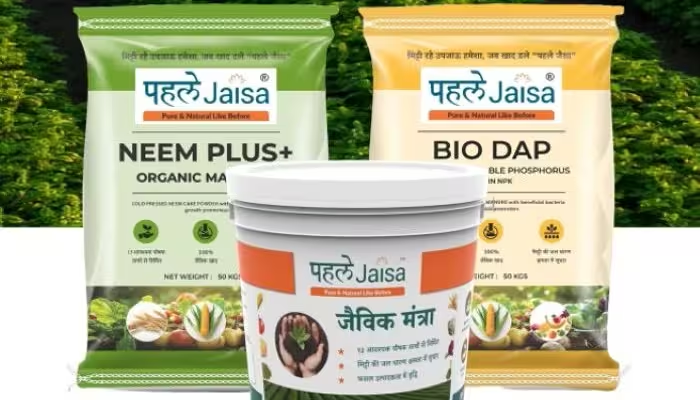
Pehle Jaisa converts organic and agricultural waste (especially from poultry farms, dairies, bio-CNG plants, etc.) into value – producing organic fertilizers, soil conditioners, and bio-stimulants, and offering on-site waste-processing solutions to farms.
Their motto calls for “healthy soil” – urging farmers to “say No to chemical fertilizers.”
What They Offer
Pehle Jaisa operates in the agritech and sustainable agriculture sector, with a strong focus on rural waste management and circular economy practices. The startup’s core offerings include organic fertilizers, soil conditioners, and bio-stimulants, all produced through the scientific processing of agricultural and animal waste sourced from poultry farms, dairies, bio-CNG units, and other organic-waste generators.
In addition to manufacturing these soil-enriching products, Pehle Jaisa provides on-site waste-to-resource solutions, setting up decentralized processing units within or near villages. This approach converts waste into high-quality organic inputs right at the source, reducing logistics costs, improving sustainability, and ensuring farmers get fresher, nutrient-rich products.
Their solutions help farmers rebuild soil health, enhance water retention, reduce reliance on chemical fertilizers, and adopt more regenerative farming practices.
Problems They Are Addressing
Pehle Jaisa is tackling the deep-rooted challenge of soil degradation in Indian agriculture, a problem largely driven by decades of excessive chemical fertilizer use. Over time, this has depleted soil organic matter, weakened soil structure, and reduced the land’s natural ability to retain water and nutrients – ultimately hurting farm productivity and long-term sustainability.
Alongside this, the startup is addressing the waste management crisis in rural India, where poultry farms, dairies, and bio-CNG units generate significant volumes of organic waste. When not managed properly, this waste often ends up polluting soil, water bodies, and the surrounding environment, while also contributing to greenhouse gas emissions.
By converting this waste into high-quality organic fertilizers through localized processing, Pehle Jaisa turns an environmental liability into a valuable agricultural resource. This not only creates a cleaner, healthier ecosystem but also makes organic inputs more affordable and accessible for rural farmers – a key hurdle that has historically prevented widespread adoption of organic farming. Their decentralized model further reduces the carbon footprint associated with transportation and supports a more circular, self-sustaining rural economy.
The Team

Pehle Jaisa was co-founded by Pankaj Pandey, Ehtesham Farooqui, along with Shabih Abbas, Sumit Suman, Wasim Akhtar and Mantosh Kumar.
The founding team brings together expertise spanning animal husbandry, waste management, agronomy, and rural-market development – giving them a good understanding of both the technical and ground realities of Indian agriculture. This blend of domain knowledge (agriculture, waste processing) along with entrepreneurial drive is a core strength for the startup.
Business Model
Hyperlocal / decentralized production: Instead of centralized large-scale manufacturing, Pehle Jaisa sets up processing centres in villages or close to farms where waste is generated. Waste is collected locally and processed on-site, converting it directly into organic fertilizers. This reduces “first-mile” transportation costs and inefficiencies.
Direct supply to farmers & rural markets: The output – organic fertilizers, bio-stimulants, soil conditioners – is supplied directly to farmers, offering them a more sustainable, soil-friendly, and cost-effective alternative to chemical fertilizers.
Revenue from sale of organic inputs: The company generates revenue via sale of fertilizers and related products.
Scalable village-centric model: Because waste generation is ubiquitous in rural/agricultural India, the model is scalable – as more villages adopt it, Pehle Jaisa can expand its processing units and reach. Currently, they are operating in 10 districts with plans to expand across Bihar, Jharkhand and the North-east states
In short: waste → processing (local) → organic fertilizer → sale to farmers → revenue.
Financial Backing & Expansion Plans
Pehle Jaisa raised its pre-Series A funding in June 2025, marking a significant step in its expansion. This followed an earlier seed round that supported the startup’s foundational operations.
With this new funding, the startup plans to expand its decentralized waste-to-fertilizer operations across more villages, set up additional local processing units, upgrade its technology, and roll out customized organic fertilizer products tailored for different crops and soil types.
This financial backing and strategic expansion indicate growing investor confidence in sustainable, rural-centric agritech solutions, and a push toward scaling at a national level.
Why Climate Angels Backed Pehle Jaisa
There are several reasons that moved the needle in favour of Pehle Jaisa:
Pehle Jaisa transforms animal waste into wealth, creating high-value products like organic fertilizers and bio-stimulants. Its decentralized, low-cost processing model eliminates logistical challenges, ensuring scalability and efficiency at the source.
Pehle Jaisa taps into the growing demand for sustainable agriculture, aligning with the $600 million organic fertilizer market. Backed by a team with deep market expertise, the company is experiencing revenue growth, reflecting its operational excellence and scalable innovation.
Pehle Jaisa’s model offers a unique opportunity to invest in a high-growth, closed-loop waste-to wealth agri-econmy, increasing soil fertility and farmers’ income while reducing environmental impact.
Progress Made & Current Scenario
Within eight months of its launch, Pehle Jaisa had sold over 500 metric tonnes (MT) of organic fertilizer. For FY25, the company sold over 1,500 MT of “value-added” fertilizers..
The startup reached 20,000+ farmers, processed over 2,000+ MT of waste, has presence across 10+ districts, and works with a retail network of 200+ retailers.
Now, they are also working on developing “customized fertilizers” tailored to specific crops and regional soil conditions, implying product diversification beyond standard fertilizers.
Looking Ahead
Pehle Jaisa presents a promising model combining waste management, sustainable agriculture, and rural empowerment. By converting waste into organic inputs – at the very source – they aim to reduce its harmful environmental impact, improve soil health, and make farming more sustainable and cost-effective.
With recent funding and early traction (fertilizer sales, revenue, farmer outreach), they are poised for scaling. Their ambition to expand across villages and districts, diversify products (crop- and soil-specific fertilizers), and build a decentralized rural circular economy indicates a long-term vision beyond just fertilizer.
If they succeed as planned – building more local processing units, increasing reach, and convincing more farmers to adopt organic fertilizers – Pehle Jaisa could play a meaningful role in transforming agricultural supply chain, reduce dependency on chemical fertilizers, and contribute to ecological sustainability.