Introduction
As the world accelerates toward a low-carbon future, carbon markets have emerged as one of the most influential financial mechanisms for tackling climate change. By putting a price on greenhouse gas (GHG) emissions, these markets convert environmental responsibility into economic value – creating both incentives and accountability for emission reductions.
Today, carbon markets are reshaping the way companies, investors, and nations approach climate action – making carbon not just a cost to be managed, but an opportunity to be leveraged.
What Are Carbon Markets?

A carbon market is a system that allows the buying and selling of carbon credits – units that represent one metric ton of carbon dioxide (CO₂) or its equivalent (CO₂e) reduced, avoided, or removed from the atmosphere. The underlying logic is simple: if emitting carbon has a cost, then reducing emissions has value.
A company that reduces its emissions below its required limit can sell its surplus carbon credits for a profit. A company that is struggling to meet its emission reduction targets can purchase carbon credits to cover its excess emissions. This buying and selling of carbon credits is referred as carbon trading.
Carbon markets help allocate that value efficiently. Entities that can cut emissions at lower costs can sell their surplus credits to those facing higher abatement costs. This market-based approach enables cost-effective decarbonization and drives investment toward cleaner technologies.
According to the World Bank’s State and Trends of Carbon Pricing 2024, carbon pricing mechanisms now cover around 25% of global greenhouse gas emissions, collectively generating over US$100 billion in revenues – most of which are reinvested in green transitions.
Mechanics of Carbon Markets
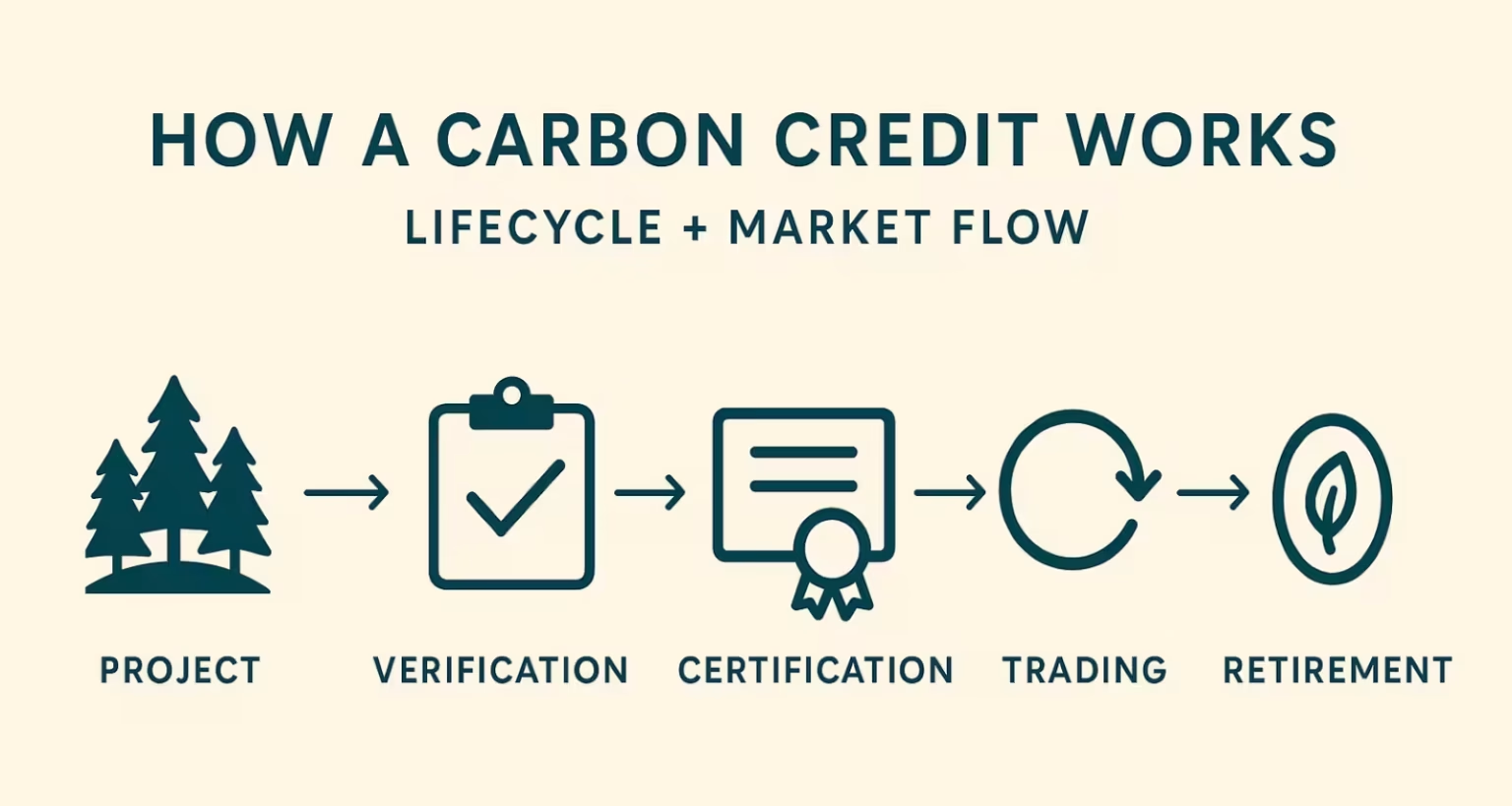
At their core, carbon markets operate through a structured, transparent process designed to ensure environmental integrity.
- Project Development: Projects that reduce or remove emissions – such as reforestation, renewable energy, or methane capture – are initiated.
- Measurement & Verification: Independent auditors measure and verify emission reductions based on established methodologies under standards like Verra (VCS) or Gold Standard.
- Issuance: Verified emission reductions are issued as carbon credits, each representing one ton of CO₂e.
- Trading: Credits can be bought and sold in compliance or voluntary markets.
- Retirement: Once used to offset emissions, credits are permanently retired from circulation to prevent reuse.
To maintain credibility, projects must meet strict criteria like additionality (the reduction wouldn’t have occurred otherwise), permanence, and no double counting. These principles underpin the market’s legitimacy and environmental impact.
Carbon markets can be either compliance markets, where governments set mandatory limits (cap-and-trade), or voluntary markets, where companies voluntarily offset their emissions.
Compliance Carbon Markets
Compliance Carbon Markets are established and regulated by governments or international bodies. They operate under legal mandates requiring entities to cap their carbon emissions and surrender allowances or credits equivalent to their output.
The most common model is cap-and-trade:
- Regulators set an overall emissions cap for a sector or region.
- Companies receive or purchase emission allowances.
- Those who emit less can sell surplus allowances to others.
Key Global Examples:
- European Union Emissions Trading System (EU ETS): Launched in 2005, the EU ETS remains the largest and most mature system, covering power generation, industry, and aviation. It has been instrumental in reducing emissions by nearly 37% in covered sectors between 2005 and 2022.
- China’s National ETS: The world’s largest by volume, covering over 4 billion tons of CO₂, initially focusing on the power sector but expanding to steel and cement.
- California Cap-and-Trade Program: A model sub-national system linking economic growth with emission reduction.
These systems not only create market signals but also encourage long-term investments in cleaner energy and technologies.
Voluntary Carbon Markets
Voluntary Carbon Markets (VCMs) operate outside of government mandates, allowing companies and individuals to voluntarily offset their emissions as part of their net-zero strategies or ESG commitments.
In these markets, demand is driven by corporate climate pledges, consumer expectations, and sustainability branding. Projects that generate voluntary carbon credits often deliver co-benefits such as biodiversity conservation, community development, or renewable energy access in developing countries.
Leading Certification Standards include:
- Verra (Verified Carbon Standard)
- Gold Standard
- Climate Action Reserve (CAR)
- American Carbon Registry (ACR)
According to the Taskforce on Scaling Voluntary Carbon Markets, the voluntary market could grow to US$50 billion annually by 2030 if integrity and transparency are maintained.
However, concerns persist about greenwashing, project quality, and double counting. Efforts by initiatives like the Integrity Council for the Voluntary Carbon Market (ICVCM) and Voluntary Carbon Market Integrity Initiative (VCMI) aim to set global benchmarks for credible participation.
Why Carbon Markets Matter
Carbon markets represent a crucial convergence of policy, finance, and innovation – turning climate goals into tangible, tradable outcomes.
- Cost-Effective Emission Reduction
Markets allocate resources efficiently by allowing emission reductions where they cost least. This lowers the overall expense of meeting national or corporate emission targets.
- Capital Mobilization
By monetizing emission reductions, markets unlock private capital for climate-positive projects – especially in developing countries that need investment in clean energy and conservation.
- Innovation Catalyst
Putting a price on carbon drives innovation in low-carbon technologies, sustainable materials, and carbon removal solutions.
- Accountability & Transparency
Trading systems create measurable, verifiable data on emission reductions, reinforcing credibility in corporate sustainability claims.
For investors, the rise of carbon markets signals new asset classes and climate-aligned opportunities that blend financial return with environmental impact.
Challenges in Carbon Markets & Carbon Trading
Despite their promise, carbon markets face significant challenges that need addressing for long-term success.
- Integrity and Quality Issues: Some carbon credits have been found to overstate emission reductions or lack permanence.
- Greenwashing Risks: Companies might offset emissions instead of genuinely reducing them.
- Regulatory Fragmentation: Different methodologies and regional rules make it hard to compare credits across markets.
- Equity & Justice: Projects sometimes fail to equitably benefit local communities or indigenous groups.
The path forward requires harmonized standards, digital tracking systems, and strong governance to ensure that carbon markets contribute authentically to climate mitigation.
Carbon Markets in International Context
Globally, more than 75 carbon pricing initiatives – including taxes and trading schemes – are operational across 50+ jurisdictions. Together, they represent a growing international movement to integrate markets under the Paris Agreement’s Article 6, which enables internationally transferred mitigation outcomes (ITMOs).
These mechanisms allow countries to cooperate, and trade verified emission reductions while avoiding double counting.
International organizations like the World Bank’s Partnership for Market Implementation (PMI) and UNDP’s Climate Promise are helping developing nations design and implement carbon pricing systems suited to local contexts.
The next frontier lies in linking regional markets, as demonstrated by the EU–Switzerland ETS linkage, which came into effect in January 2020, and connects the European Union’s and Switzerland’s emissions trading systems (ETS) to create a single, international carbon market. This linkage allows companies in both regions to use allowances from either system for compliance and enables the seamless transfer of allowances between the two registries. The linkage requires the systems to have similar rules, and ongoing reforms ensure continued compatibility, such as recent revisions to the EU ETS.
Carbon Market in Indian Context
India is stepping firmly into carbon market development. The Carbon Credit Trading Scheme (CCTS), 2023, notified by the Ministry of Power and implemented by the Bureau of Energy Efficiency (BEE), is aiming to create a unified Indian carbon market.
The scheme defines two segments:
- A compliance mechanism for 9 energy-intensive industries (aluminium, cement, chlor-alkali, fertiliser, iron & steel, petrochemicals, petroleum/refining, pulp & paper, textiles) based on emissions intensity targets; and
- A voluntary mechanism for companies and institutions pursuing carbon neutrality through projects like afforestation and renewable energy.
The Bureau of Energy Efficiency (BEE) is the central body for the scheme, responsible for setting targets and developing the framework for a credible Monitoring, Reporting, and Verification (MRV) system.
India already hosts one of the world’s largest portfolios of voluntary carbon projects, particularly in renewable energy and afforestation. With its 2070 net-zero goal, a robust domestic carbon market could channel billions in green investment, strengthen corporate accountability, and position India as a regional leader in carbon trading.
Current Scenario of Carbon Market in India
India’s carbon market via CCTS is in the advanced policy-design phase, transitioning into implementation. The legal/regulatory groundwork is in place. But active trading and large-scale issuance of credits is yet to begin.
The trading of credits under the compliance mechanism is expected to begin between 2026-27 (e.g., first trading possibly in October 2026) according to recent estimates. The offset/voluntary mechanism is still being developed; detailed methodologies are under consultation and project registration has not yet matured. No carbon credits have yet been generated under the compliance mechanism of CCTS as of December 2024.
Conclusion
Carbon markets are transforming climate ambition into measurable economic action. By pricing carbon emissions, they create accountability; by rewarding emission reductions, they mobilize innovation and capital.
For these carbon markets to reach their full potential, integrity, transparency, and inclusiveness must remain at their core. When governed responsibly, carbon markets can bridge the worlds of finance and sustainability – turning the challenge of decarbonization into one of the most promising frontiers for global cooperation and investment.