ESG Investing: The New Face of Responsible Investing
The world of investing is undergoing a quiet revolution. Increasingly, investors are looking beyond financial returns to understand how companies impact society and the planet. This shift marks the rise of ESG investing – an approach that integrates Environmental, Social, and Governance factors into investment decisions. ESG investing represents a broader movement in finance – one that recognises that long-term profitability and sustainability go hand-in-hand.
Once a niche concept, ESG has now become mainstream, driven by growing awareness of climate risks, social inequality, and corporate accountability. In fact, according to Bloomberg Intelligence, global ESG assets may surpass $40 trillion globally by 2030, highlighting the magnitude of growth in sustainable investing and signaling a fundamental transformation in how capital is allocated and measured.
What is Environmental, Social, and Governance (ESG) Investing?
ESG investing refers to an investment strategy that evaluates companies not just on their financial performance, but also on how they perform across three key dimensions:
- Environmental (E): How a company manages its environmental impact – from reducing carbon emissions and conserving resources to adopting renewable energy and waste management practices.
- Social (S): How it treats its employees, customers, and communities. This includes diversity and inclusion, labour standards, health and safety, and community engagement.
- Governance (G): How the company is managed – including board composition, executive pay, ethics, transparency, and shareholder rights.
ESG investing goes beyond traditional financial analysis to assess a company’s sustainability and ethical impact. ESG investors aim to identify companies that are sustainable, well-governed, and socially responsible, believing these businesses are better positioned for long-term success and risk resilience.
Evolution of ESG Investing
The roots of ESG investing can be traced back to Ethical Investing in the 1960s and 1970s, when investors began excluding “sin stocks” – such as alcohol, tobacco, gambling, adult entertainment, and weapons manufacturing – from their portfolios. This evolved into Socially Responsible Investing (SRI), which emphasized moral and ethical values.
The modern ESG framework took shape in the early 2000s, especially after the United Nations Principles for Responsible Investment (UN PRI) were launched in 2006. These principles encouraged institutional investors to integrate ESG considerations into their financial analysis.
Since then, ESG investing has seen exponential growth, supported by regulatory policies, corporate disclosures, and investor demand. Global events like the Paris Climate Agreement (2015) and the COVID-19 Pandemic have further reinforced the link between sustainability, resilience, and financial performance.
Today, ESG has become a central consideration in global capital markets. From pension funds to venture capital firms, investors are embedding ESG criteria to future-proof their investments against environmental and social risks.
Real-World Examples of ESG Investing
Several companies and funds exemplify successful ESG integration:
- The Norwegian Government Pension Fund Global (GPFG) has a strict policy of excluding companies involved in activities deemed unethical, including coal mining, tobacco production, weapons manufacturing, and gambling operations. GPFG has excluded more than 200 companies from its investment universe due to violations of its ethical guidelines, with notable divestments including Glencore and Philip Morris International.
- ReNew Power, one of India’s largest renewable energy companies, has attracted billions in ESG-focused investment for solar and wind projects. It secured an investment of around USD 100 million from British International Investment (BII) in May 2025 and recently secured $331 million in funding from the Asian Development Bank (ADB).
- Ørsted, formerly DONG Energy, once focused on oil and coal but has since divested from fossil fuels and invested in offshore wind farms. This strategic pivot made Ørsted a global leader in renewable energy and stands as a model for decarbonization in heavy industry. The company’s value and global reputation saw a significant uplift, resonating with green investors and stakeholders.
- Bank of America is committed to providing $300 billion in financing by 2030 to sustainable business activities through its Environmental Business Initiative. This included funding for renewable energy projects, energy-efficient infrastructure, and support for small businesses engaged in sustainable practices.
There are many such examples that demonstrate that ESG investing is not just about “doing good” – it’s also about identifying companies that are innovating and managing risks effectively.
How ESG Investing Works
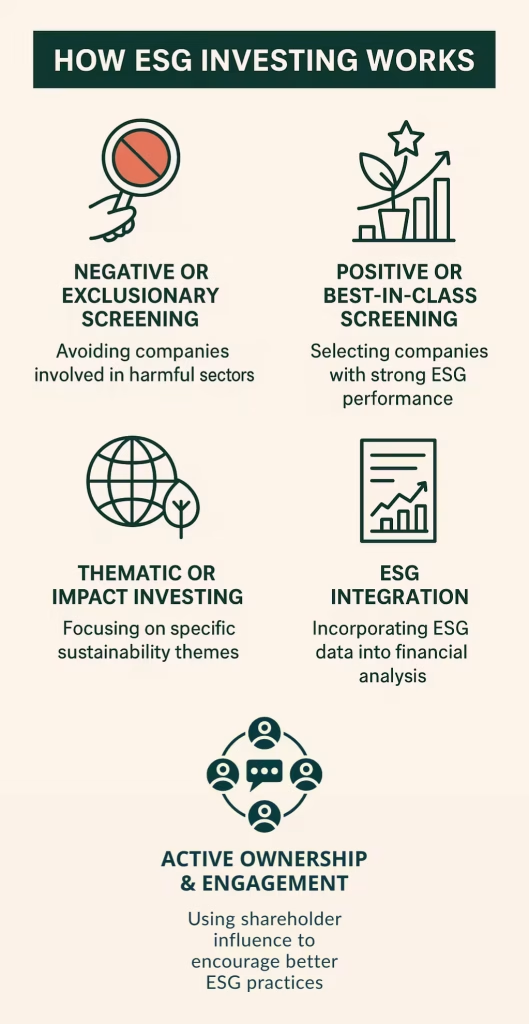
At its core, ESG investing involves integrating sustainability factors into investment analysis and decision-making. The goal is to identify businesses that are not only profitable but also responsible and resilient in the long term.
Investors use several approaches:
- Negative or Exclusionary Screening:
Investors exclude industries or companies that conflict with their values or sustainability goals – for example, those involved in fossil fuels, tobacco, weapons, or environmental damage. This approach ensures that portfolios reflect ethical considerations while avoiding reputational or regulatory risks. - Positive or Best-in-Class Screening:
Instead of simply avoiding certain sectors, investors actively seek out companies that perform better than their peers on ESG parameters. These are the “leaders” setting benchmarks in areas like carbon reduction, gender diversity, or governance transparency. - Thematic or Impact Investing:
This focuses on specific sustainability themes such as renewable energy, clean water, waste reduction, or affordable housing. Thematic ESG investing allows investors to align their portfolios with targeted global goals – like the UN Sustainable Development Goals (SDGs). - ESG Integration:
In this approach, ESG data is woven directly into the investment decision-making process, alongside financial metrics such as revenue growth and profitability. For example, a company’s carbon exposure might be treated as a long-term cost risk in valuation models. - Active Ownership and Engagement:
Investors don’t just buy shares and step back – they use their shareholder influence to encourage better ESG practices. This could include voting on sustainability resolutions, engaging with management on climate targets, or pushing for greater board diversity and transparency.
ESG investing thus creates a dual lens for investors: assessing both financial performance and non-financial sustainability factors. With the growing availability of ESG ratings and analytics from agencies such as MSCI, Sustainalytics, and Refinitiv, investors can now make data-driven decisions to build more sustainable, risk-resilient portfolios.
ESG Metrics
ESG investing matters because it aligns profit with purpose.
- Risk Management: Companies with robust ESG policies are often better prepared to handle regulatory, reputational, and operational risks.
- Long-term Performance: Several studies suggest ESG-integrated portfolios can deliver competitive or superior returns over time.
- Investor Demand: Millennial and Gen Z investors increasingly prefer investments that reflect their values.
- Access to Capital: Companies with strong ESG scores can attract lower-cost financing and long-term institutional investors.
Ultimately, ESG investing helps direct capital toward businesses that contribute to sustainable economic growth, social equity, and environmental protection.
Challenges & Criticisms of ESG Investing
Despite its promise, ESG investing faces notable challenges:
- Greenwashing: Some companies overstate their ESG credentials to attract investors, making it difficult to separate genuine performers from pretenders. This highlights the need for stronger verification mechanisms and standardized ESG reporting frameworks.
- Lack of Standardisation: With varying rating methodologies, ESG scores can differ widely across agencies. ESG ratings and frameworks often lack transparency and can be misleading. There are concerns that these ratings do not adequately reflect a company’s true sustainability performance and exaggerate its environmental efforts to attract investors.
- Data Gaps: Especially in developing markets, incomplete or inconsistent disclosures hamper accurate assessment. Improving data quality and transparency is essential for building investor trust and ensuring fair comparisons across regions.
- Short-term Focus: Some investors still prioritize quarterly returns over long-term sustainability goals. Economic uncertainties are leading these investors to focus on financial returns over social and environmental considerations.
The Future of ESG Investing

The future of ESG investing is set to be shaped by technology, institutional adoption, and emerging markets.
- Technology and Data Innovation:
AI, big data, and analytics are transforming ESG investing by improving how environmental and social data are collected, verified, and analyzed. These tools help detect “greenwashing” and enhance transparency. Meanwhile, instruments like green bonds and sustainability-linked loans are expanding access to capital for climate-positive projects. Global standards such as the International Sustainability Standards Board (ISSB) and Climate‑related Financial Disclosures (TCFD) are also driving greater consistency in ESG reporting. - Institutional Momentum:
Large investors – including pension funds and sovereign wealth funds – are embedding ESG principles into their strategies to manage long-term risks and ensure sustainable returns. Regulatory frameworks like the EU’s Sustainable Finance Disclosure Regulation (SFDR) and India’s Business Responsibility and Sustainability Reporting (BRSR) are reinforcing this shift by making ESG disclosures more transparent and mandatory. - The Role of Developing Markets:
Countries like India are emerging as vital players in ESG investing, with growing interest in ESG funds, renewable energy, and sustainable innovation. Policy measures and corporate commitments to net-zero goals are strengthening the foundation for responsible investment in these regions.
In essence, ESG investing is evolving from a niche concept to a core pillar of global finance – powered by better data, stronger regulations, and a shared commitment to building a more sustainable economy.
How Is ESG Investing Related to Climate Investing?
Climate investing is a subset of ESG investing, focusing specifically on mitigating climate change and promoting low-carbon solutions.
While ESG investing covers a broader set of issues (including social and governance factors), climate investing zooms in on environmental impact – such as investing in strategies/innovations that mitigate climate change (such as reducing greenhouse gas emissions, supporting renewable energy, or financing adaptation technologies) as well as adaptation efforts to make societies more resilient to climate impacts (like climate-smart agriculture or flood defences).
In other words, all climate investing is ESG investing, but not all ESG investing is climate investing. ESG offers a holistic framework that includes – but is not limited to – climate-related goals.
Conclusion
ESG investing represents more than a financial trend; it’s a redefinition of what it means to invest responsibly. By evaluating how companies affect people, planet, and profits, ESG investing empowers investors to create long-term value while driving meaningful change.
As regulatory frameworks mature and investor awareness deepens, ESG investing will continue to evolve from a “nice-to-have” to a “must-have” component of portfolio strategy.
Looking ahead, the continued alignment of capital markets with sustainability goals will be crucial in addressing global challenges such as climate change, inequality, and governance failures. As more investors demand transparency, accountability, and real-world impact, ESG investing will not only influence corporate behaviour but also shape policy, innovation, and global capital flows – proving that responsible investing is, indeed, smart investing.