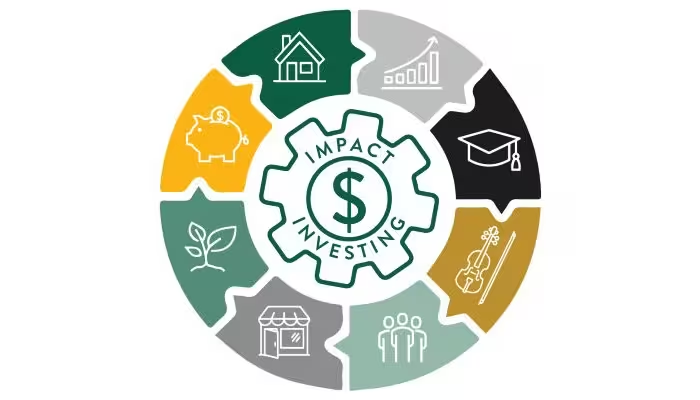
In an era where financial returns alone no longer satisfy investors, impact investing has emerged as a powerful bridge between profit and purpose globally. This investment approach seeks to generate measurable social and environmental benefits alongside financial returns, fundamentally reimagining what it means to deploy capital in the modern economy.
Defining Impact Investing
Impact investing refers to investments made into companies, organizations, and funds with the intention to generate a measurable, beneficial social or environmental impact alongside financial returns. At its core, impact investing is about an alignment of an investor’s beliefs and values with the allocation of capital to address social and/or environmental issues.
Unlike ‘traditional philanthropy’, which gives money away without expecting financial returns, or ‘conventional investing’, which prioritizes profits above all else, impact investing occupies a unique middle ground. Investors in this space purposefully target projects, companies, or funds that tackle global challenges like poverty, access to healthcare, education, clean energy, and environmental sustainability, while also expecting financial returns.
The practice has grown rapidly since it was introduced by the Rockefeller Foundation in 2007, reflecting increasing demand from capital markets for investments tied to global improvement. Impact investing can be applied across asset classes, including stocks, bonds, private equity, mutual funds, and microloans, making it an accessible approach for diverse investor types.
Key Elements of Impact Investing
The Global Impact Investing Network (GIIN) identifies four core characteristics of impact investments:
- Intentionality: Investments are made with a stated intention to generate positive impact.
- Measurability: Social and environmental outcomes must be tracked and quantified.
- Financial Returns: Investments seek – though not always prioritize – a financial gain alongside impact.
- Sector Diversity: Impact investing spans industries including clean energy, healthcare, education, agriculture, microfinance, and more.
Examples of Impact Investing in Various Sectors
- Affordable Housing Initiatives: Investment funds pool capital from institutional investors to develop housing projects in underserved communities, providing stable returns through tax credits while addressing the housing affordability crisis.
The Low-Income Housing Tax Credit (LIHTC) Program in the United States has attracted billions in impact investment to create affordable housing units.
- Renewable Energy Projects: Impact investors have poured substantial capital into solar and wind energy projects worldwide. For instance, community solar programs allow investors to fund solar installations that provide clean energy to low-income households while generating returns through energy sales. These investments simultaneously combat climate change and reduce energy costs for vulnerable populations.

A pivotal case is the $12 million investment in Solar Micro/Mini-Grids across rural Kenya, which brought electricity to 18,000 households, helped 340 small businesses extend operating hours, and improved service delivery at 15 health clinics. This initiative showcases how capital deployment can directly uplift communities while creating viable commercial opportunities for investors.

Another example is Bhadla Solar Park in Rajasthan, which is India’s largest solar power plant with 2,245 MW capacity across 14,000 acres, and attracted major institutional investors and developers. The park contributes to India’s renewable energy goals and helps reduce greenhouse gas emissions by an estimated 4 million tons per year.
- Microfinance and Financial Inclusion: Perhaps one of the earliest and most established forms of impact investing, microfinance provides small loans to entrepreneurs in developing countries who lack access to traditional banking.

- Healthcare Access: Impact investments have expanded healthcare access in underserved regions. For example, Social Impact Bonds (SIBs) have funded preventive healthcare programs, where investors provide upfront capital for initiatives like vaccination campaigns or chronic disease management, with returns tied to successful health outcomes.
SIB-funded Newcastle’s Ways to Wellness, UK, targeted individuals aged 40-74 with long-term conditions in deprived areas. The program uses “social prescribing,” where non-medical link workers help patients identify health and well-being goals and connect with community resources, with the goal of improving well-being and reducing costly secondary healthcare usage (e.g., hospital stays). The service is funded by a Social Impact Bond investment from Bridges Ventures.
- Sustainable Agriculture: Impact funds invest in agricultural businesses that promote sustainable farming practices, fair wages for farmers, and environmental conservation. These investments support the transition from industrial agriculture to regenerative practices while creating market-rate returns through improved productivity and premium pricing for sustainably produced goods.
In Vietnam, platforms like TechCoop (agri-fintech) and Con Trâu Eco (climate-smart farming) benefited from blended finance in Vietnam’s rapidly maturing impact-investment ecosystem. These efforts have improved agricultural efficiency and reduced carbon footprints, signifying how local enterprises can flourish with impact-driven capital.
Measuring Success of Impact Investing
A vital characteristic of impact investing is ongoing “measurement”. Investors and funds are increasingly required to report data on outcomes such as tonnes of CO₂ reduced, renewable energy generated, people lifted from poverty, or lives improved through health access. This transparency ensures accountability and helps scale what’s working.
Market Size, Challenges & Future Outlook of Impact Investing
The Global Impact Investing Network (GIIN) estimated the global impact-investing market at about $1.57 trillion in assets under management in their 2024 sizing exercise – a number that is growing year after year. That same landscape report also shows that impact investors deployed tens of billions of dollars into deals during recent years.
Despite its promise, impact investing faces several challenges. Measuring impact remains complex and inconsistent across the industry, making it difficult for investors to compare opportunities or verify claims. The risk of “impact washing” – where investments are marketed as impactful without genuine social or environmental benefits – also concerns many stakeholders.
Additionally, some critics argue that truly transformative social change may require accepting below-market returns, creating tension between impact and profit maximization. The question of whether impact investing can address systemic issues or merely treats symptoms continues to spark debate.
However, global interest in impact investing is surging, with markets like India projected to absorb $6-8 billion of impact capital annually by 2025 if hurdles are cleared, as per McKinsey & Co’s 2017 forecast. Infact, impact investing in India exploded to $4.96 billion in 2024 across 438 enterprises, as per India Impact Investors Council’s (IIC) “2024 in Retrospect,” with agriculture, climate tech, and financial inclusion leading.
As climate change intensifies and social inequality persists, impact investing is gradually moving from niche to mainstream. Institutional investors, venture capitalists, charitable foundations, and even retail investors are participating more actively in this space, often aided by dedicated platforms and funds. Market participants and governments are working to standardize reporting and develop certification programs to improve quality and credibility.
All these are creating an ecosystem where doing well financially and doing good socially are increasingly viewed as complementary rather than contradictory goals.
How is Impact Investing related to Climate Investing?
Impact investing and climate investing are closely related, but not identical. Climate investing is essentially a subset of impact investing, focused specifically on addressing climate change through capital allocation.
Relationship and Overlap
- Impact investing targets measurable positive social or environmental outcomes alongside financial returns. These outcomes span a broad range, including poverty alleviation, education, health, gender equality, and environmental protection.
- Climate investing specifically channels funds into strategies that mitigate climate change (such as reducing greenhouse gas emissions, supporting renewable energy, or financing adaptation technologies) as well as adaptation efforts to make societies more resilient to climate impacts (like climate-smart agriculture or flood defences).
All climate investments qualify as impact investments because they intentionally seek a positive environmental impact – in this case, reducing or adapting to climate change. However, not all impact investments are climate-related; they may address social challenges unrelated to the environment.
Examples of Overlap
- Investments in renewable energy projects (solar, wind, hydro), energy efficiency, sustainable infrastructure, and carbon capture are all forms of climate investing – and are often structured as impact investments when they explicitly set and report on climate outcomes like tonnes of CO₂ avoided.
- Major funds like BlackRock’s Climate Transition Fund, Temasek’s GenZero, and BlueOrchard’s climate strategies channel billions into climate solutions while also measuring the impact in carbon reductions or energy generated.
Conclusion
Impact investing offers a powerful approach for those who wish to align their capital with their values, supporting enterprises that create tangible social or environmental change, while still targeting robust financial outcomes.
As measurement tools, investor sophistication, and market infrastructure improve, impact investing is poised to become a standard part of global investment strategies – helping to solve pressing challenges with purpose-driven capital.