
Introduction
The world of investing is changing fast. Investors today are no longer content with simply allocating capital across sectors or regions – they want to invest in big ideas that reflect how the world is evolving. Themes like artificial intelligence (AI), clean energy, ageing populations, and digital finance are reshaping industries and creating new frontiers of opportunity.
In this context, an investment approach called thematic investing has gained traction: rather than picking stocks by sector or region, you pick ideas – big ideas about how the world will evolve – and allocate capital accordingly. As such, thematic investing offers a bridge between capital and change, where an investor aligns resources with future-facing trends.
What is Thematic Investing?
Thematic investing is a long-term investment strategy focused on identifying long-term themes or structural trends that are expected to drive significant change across economies and industries, and then investing in companies that are positioned to benefit from those themes.
In more practical terms, rather than saying “I’ll invest in technology companies” or “I’ll invest in emerging-market consumer stocks”, thematic investing might say “I believe the rise of artificial intelligence (AI) and automation will reshape multiple industries – so I’ll invest in companies across sectors that are leaders or enablers of that transformation.”
Unlike a classic sector fund (which might focus only on, say, the technology sector), a thematic fund or investment approach often cuts across many sectors, and sometimes geographies.
For example, a “Future Mobility” theme might include Tesla and BYD (electric vehicles), Samsung SDI (battery technology), and Tata Motors (EV transition in India). Similarly, a “Digital Transformation” theme could include global cloud giants like Amazon Web Services, as well as Indian IT leaders such as Infosys and TCS, which enable that transition worldwide.
Characteristics of Thematic Investing
Some of the defining traits of thematic investing include:
- Forward-looking Orientation – Thematic investing is inherently about the future, anticipating change rather than just relying on past trends.
- Cross-sectoral Coverage – Since themes are about big forces (e.g., climate transition, digitalisation), companies benefiting may lie in different sectors (energy, materials, technology, consumer).
- Long Investment Horizon – Because themes evolve over years (sometimes decades), thematic investing often requires patience and a long-term view.
- Narrative-driven, with Conviction – Investors must believe in the underlying story (this theme will matter) and be willing to commit to it.
- Potentially Higher Concentration/Risk – By focusing on a theme, you may sacrifice some of the diversification of broad-market investing; the risk is that the theme doesn’t play out as expected.
- Multi-asset or Equity-centric Flexibility – While often equities, thematic strategies may extend into bonds, real assets or blends depending on how the theme manifests.
Core Areas of Thematic Investing
What kinds of themes are common in the market today?
Here are the main categories:
Category | Examples (Global + Indian Context) |
Technology & Innovation | Artificial Intelligence (NVIDIA, Alphabet); Robotics (ABB, Fanuc); Indian SaaS and fintech players like Zoho, Razorpay, and Paytm. |
Sustainability & Climate Transition | Global clean energy leaders like Ørsted and NextEra Energy; Indian renewable majors like Adani Green Energy, ReNew Power, and Tata Power. |
Demographics & Social Change | Ageing population funds in Japan and Europe; India’s “young consumer” theme with companies like Titan, DMart, and Zomato. |
Health & Wellness | Biotechnology innovators (Moderna, Gilead Sciences); India’s healthcare and pharma sector (Dr. Reddy’s, Apollo Hospitals). |
Future of Work & Digital Economy | Cloud and automation (Microsoft, Salesforce); India’s IT services and start-ups driving remote work and digital inclusion. |
Within each of these broad buckets are many sub-themes. For example, under sustainability, you might pick electric vehicles, battery technology, or carbon capture. Under demographics, you might pick silver-economy plays or emerging-market consumer shifts.
How Thematic Investing Works
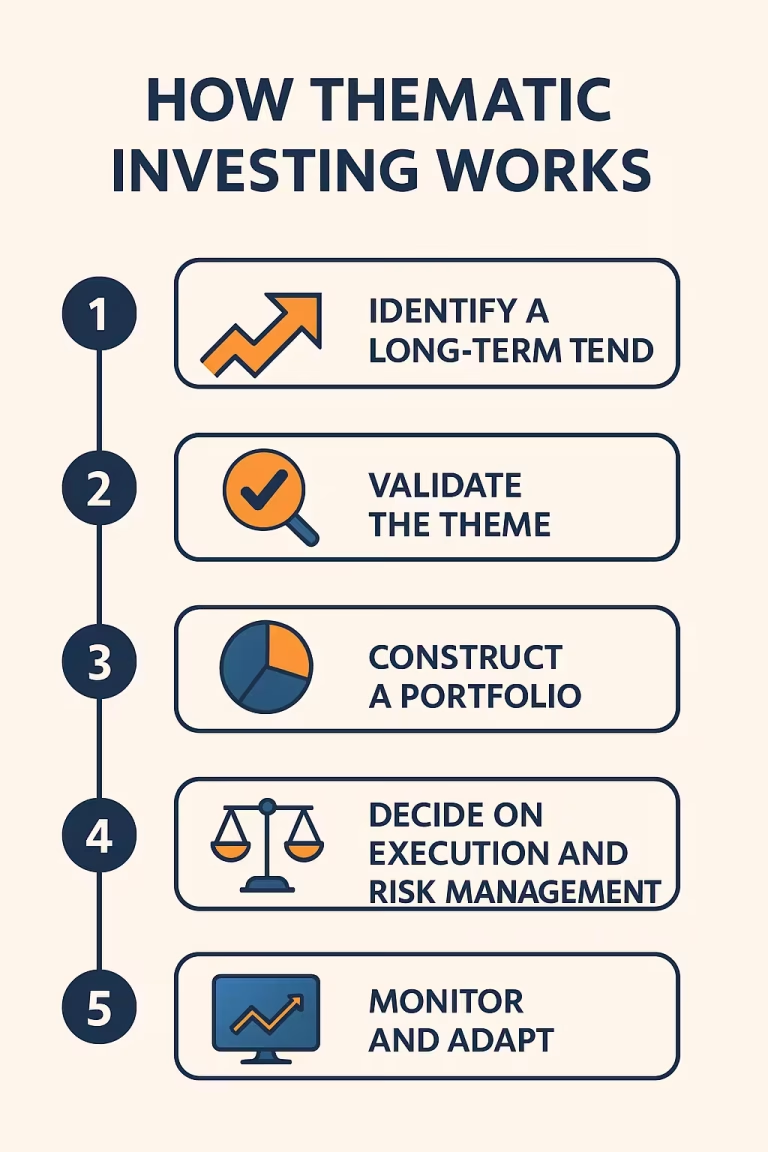
Here’s a step-by-step way to look at how thematic investing generally works:
- Identify a Long-term Trend/Megatrend.
The investor or fund examines what large forces are likely to shape the future (e.g., climate policy, AI adoption, urbanisation). For example, the renewable energy theme focuses on companies enabling solar, wind, and storage solutions.
- Validate the Theme.
Using research, data, market signals and expert insight to assess whether the theme is durable, structural (not just a fad), global and cross-sectoral. Investors assess macro drivers like policy incentives (e.g., India’s Production Linked Incentive Scheme for EVs or the U.S. Inflation Reduction Act).
- Construct a Portfolio Around the Theme.
Select companies (or securities) that stand to benefit from the theme – these may span sectors & geographies. For instance, a “Smart Mobility” fund might include Tesla, BYD, Bosch, and Indian component makers like Motherson Sumi.
- Investment Vehicle:
Exposure can be gained through ETFs, mutual funds, or custom thematic portfolios. Global examples: iShares Global Clean Energy ETF, ARK Innovation ETF. Indian examples: Motilal Oswal NASDAQ 100 ETF (tech focus), ICICI Prudential Green Energy Fund.
- Decide on Execution and Risk Management.
You may choose a passive thematic index, an actively-managed thematic fund, or direct stock investments. Important to assess valuation, diversification, timing, and how much allocation you give to this theme versus the rest of your portfolio.
- Monitor & Adapt.
Because themes evolve, competition emerges, business models change, investor sentiment cycles in and out – the thematic exposure may need re-visiting. Also, watch whether the theme is still valid, or whether valuations have gone ahead of fundamentals.
Challenges & Criticism of Thematic Investing
Thematic investing is appealing, but it comes with real caveats:
- Timing Risk – A theme may take many years to play out, or it may be priced in already. Investors may have to wait a long time before returns accrue.
- Over-concentration Risk – Because you’re focused on a few themes, you may reduce diversification and increase vulnerability to theme-specific setbacks.
- Hype & Narrative Risk – Some thematic funds launch at the peak of enthusiasm; when the narrative changes or disappoints, performance suffers. As seen with “metaverse” or “blockchain” themes, short-lived excitement can inflate valuations.
- Lack of Standardization & Definition – Thematic investing is not always clearly defined; two funds labelled the same theme may have very different holdings or exposure. For example, what counts as a “clean energy” or “AI” company varies widely across funds.
- Valuation Risk – The future promise of a theme might already be priced into stocks, meaning less upside and more risk.
- Implementation Risk – Picking the right companies, at the right time, in the right weight is challenging. Also, measuring real exposure to the theme is non-trivial.
In short, thematic investing works best when grounded in rigorous research, not storytelling alone.
Is Thematic Investing Related to Climate Investing?
It is – but with nuance.
- Overlap: Many thematic investing strategies include climate transition, decarbonisation, clean energy, circular economy, sustainable infrastructure. In that sense, climate investing can be seen as one of the themes within the broader thematic investing universe.
- Distinction: Whereas thematic investing covers many themes (technology, demographics, social change, etc.), climate investing focuses on the set of structural changes tied to the environment, energy transition, and sustainability.
- Relationship in Practice: If an investor selects a “Green Transition” theme, that is effectively climate investing; but if they pick “AI & Automation”, it may have little or no climate exposure. So, thematic investing offers the flavour of climate investing if the theme is climate-linked, but thematic doesn’t always mean climate.
For investors oriented around sustainability, thematic frameworks allow them to integrate climate-related themes in a structured way – for example, “Invest in the electrification of transport”, which is both thematic and climate-related. A “Green Transition” thematic fund may invest in global leaders like Siemens Gamesa and India’s JSW Energy – blending clean tech innovation with domestic energy reform.
Thus, climate investing can be seen as a focused lens within the broader thematic framework.
Current Scenario & Way Forward
Thematic investing is seeing surges in popularity. For instance, assets managed in U.S.-listed thematic funds rose from about US$9.7 billion in 2014 to about US$92.7 billion in 2024. One of the dominant themes in 2025 is AI and geopolitics. BlackRock highlights how AI and geopolitical fragmentation are reshaping investment opportunity sets globally.
At the same time, increased interest in sustainability, transition investing and infrastructure is visible across markets – including in India, where transition-investing appetite among HNIs is very high. But, as noted above, the performance track record is mixed and the risk of hype is real: early entrants to themes often perform better than those entering after the wave.
Way Forward
- Focus on Theme Durability: Investors should distinguish between a long-lasting structural theme versus a short-lived fad.
- Valuation Discipline: Even if a theme is good, entry price matters. If valuations are stretched, the risk is elevated.
- Diversification within Thematic Exposure: Instead of putting a large share of your portfolio into one theme, treat thematic exposure as a component of a broader diversified strategy.
- Integration with Broader Portfolio: Thematic exposures should complement (not replace) core holdings. Think of them as satellite allocations rather than the entirety of portfolio.
- Continual Review & Adaptation: Themes evolve, business models change, regulation shifts. What worked yesterday may not work tomorrow – the investor must stay informed.
- Greater Sophistication in Implementation: As data, research and analytics improve (for example using AI/ML to screen theme-relevant stocks) thematic investing may become more robust and nuanced.
Thematic Investing in the Indian Context
India’s rapid economic expansion, urbanisation, and policy-driven focus on sectors like renewable energy, electric mobility, digital infrastructure, and healthcare make it a fertile ground for thematic investing. Themes such as “Digital India,” “Make in India,” and “Green Energy Transition” have already drawn investor attention – both domestic and global.
However, thematic investing in India comes with unique considerations. Market liquidity and sector depth can vary widely, making it harder to construct diversified portfolios within a single theme. Valuation anomalies – particularly in fast-growing sectors like EVs or green tech – can inflate short-term expectations. Furthermore, India’s evolving regulatory and policy landscape adds a layer of regime risk that investors must actively monitor.
Despite these challenges, India’s long-term structural trends, supported by demographic advantages and government incentives, continue to make thematic investing an attractive strategy for those with a well-researched and disciplined approach.
Conclusion
In a world of accelerating change, thematic investing offers a compelling framework: it allows investors to align capital with the forces shaping the future rather than simply chasing past winners. However, vision must be paired with discipline. A good theme alone isn’t enough – finding the right companies, paying reasonable valuations, managing risk and staying diversified all matter.
Whether you’re drawn to the electrification of transport, the rise of generative AI, the sustainable-food chain, or the silver economy, thematic investing bridges the gap between what you believe the future will be and how you participate in it. Approach it thoughtfully, and it can be a powerful addition to your investment playbook.