Introduction
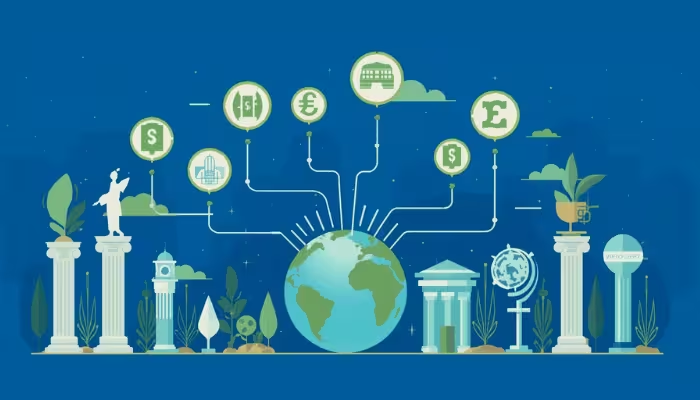
Climate finance has emerged as the backbone of global efforts to address climate change. According to the United Nations Framework Convention on Climate Change (UNFCCC), developing countries alone will need to invest over US$2.4 trillion annually by 2030 to meet their climate goals – a scale that far exceeds current climate finance flows. To bridge this gap, an intricate network of global, multilateral, and regional funding institutions has evolved to mobilize capital for both mitigation and adaptation.
From large multilateral development banks (MDBs) to specialized climate funds, these bodies play distinct but complementary roles. Some channel concessional loans or grants for renewable energy, resilience, and adaptation projects; others de-risk private capital through guarantees, blended finance, and co-investment platforms. Together, they form the global architecture of climate finance – enabling the world to move from pledges to implementation.
1. The World Bank Group: A Leading Anchor in Climate Finance
The World Bank Group (WBG) remains one of the largest multilateral sources of climate finance. In fiscal year 2023, it delivered a record US$38.6 billion in climate finance – nearly 46% of its total commitments – across renewable energy, sustainable agriculture, and resilient infrastructure projects.
The Bank’s Climate Change Action Plan 2021-2025 aims to integrate climate considerations into all operations, while its International Finance Corporation (IFC) and Multilateral Investment Guarantee Agency (MIGA) mobilise private-sector financing. IFC alone has committed to align all new investments with the Paris Agreement by 2025.
Geographically, the WBG channels funds globally, with a strong focus on low- and middle-income countries in Africa, Asia, and Latin America. Projects include solar parks in India, green corridors in Egypt, and climate-smart agriculture in Sub-Saharan Africa. Its scale and convening power make the World Bank central to the climate finance ecosystem.
Why it matters?
Because of its size, convening power, and ability to blend public and private financing, the WBG helps unlock massive scale. It’s often the anchor institution that others build around.
2. The International Monetary Fund: Integrating Climate into Macroeconomic Stability

Traditionally focused on macroeconomic stability, the International Monetary Fund (IMF) has increasingly recognized climate risks as financial risks. In 2022, it launched the Resilience and Sustainability Trust (RST) – a US$40 billion fund designed to help vulnerable countries strengthen climate resilience and sustainability through long-term, low-interest loans.
The RST targets countries already facing debt distress and limited fiscal space, linking climate policy reforms with broader economic stability. For example, IMF support has helped nations such as Costa Rica and Rwanda integrate climate risk assessments into fiscal frameworks.
Though not a direct project financier like the World Bank, the IMF’s role in shaping macroeconomic policy makes it pivotal in ensuring that climate finance is sustainable and equitable.
Why it matters?
The IMF is uniquely positioned to make climate finance sustainable – not just by funding projects, but by ensuring that climate goals are baked into national economic planning, debt sustainability, and macro-policy frameworks.
3. The Green Climate Fund: The Flagship of the UN System
Established under the UNFCCC in 2010, the Green Climate Fund (GCF) is the world’s largest dedicated climate fund, designed to support developing countries in both mitigation and adaptation. As of 2024, the GCF has mobilized over US$15.9 billion in pledges from developed nations, backing around 286 projects in 133 countries.
The GCF operates through accredited entities – including UN agencies, MDBs, and national banks – to channel grants, loans, guarantees, and equity investments. It prioritises transformational projects such as coastal resilience in Bangladesh, sustainable transport in Latin America, and off-grid solar access in Africa.
Crucially, the GCF’s direct access modality enables developing countries to access finance without intermediaries, fostering local ownership and capacity building.
Why it matters?
The GCF helps align global climate finance with local ownership and capacity building. Its direct-access model is particularly powerful for developing countries to take charge of their own climate investments.
4. The Global Environment Facility: Long-Standing Multilateral Support

The Global Environment Facility (GEF), established in 1991, predates most climate funds and serves as a key financing mechanism for the UNFCCC, Convention on Biological Diversity (CBD), and other conventions. Over three decades, it has disbursed more than US$23 billion in grants, leveraging an additional US$129 billion in co-financing through the implementation of 5,000 projects and programs.
The GEF supports projects addressing biodiversity, land degradation, and climate change mitigation – often through blended-finance structures that mobilize private capital. Its regional focus spans Africa, Asia-Pacific, Latin America, and Small Island Developing States (SIDS).
Recent GEF initiatives, such as the Least Developed Countries Fund (LDCF) and Special Climate Change Fund (SCCF), specifically target the most vulnerable nations for adaptation support.
- Least Developed Countries Fund (LDCF) – targets the most climate-vulnerable, low-income countries.
- Special Climate Change Fund (SCCF) – supports innovation, technology transfer, private sector engagement, and specific adaptation needs (especially for small island developing states).
Why it matters?
GEF’s long track record, institutional experience, and ability to blend grants with other sources make it a cornerstone of global environmental and climate finance.
5. The Adaptation Fund: Financing Vulnerability and Resilience
The Adaptation Fund (AF), established under the Kyoto Protocol in 2001, exclusively finances adaptation projects in developing countries that are particularly vulnerable to climate impacts. Unlike many funds, it is financed partly through a share of proceeds from carbon credit mechanisms (Certified Emission Reductions).
Since 2010, the AF has committed over US$1.25 billion to more than 183 projects in over 100+ countries, supporting coastal resilience, flood management, and agriculture adaptation. It was the first fund to introduce the “Direct Access” modality, empowering national institutions to receive and implement funds without intermediaries.
Geographically, the fund’s footprint spans Africa, Asia, Latin America, and Small Island Developing States (SIDS), where adaptation needs are most acute.
Why it matters?
The Adaptation Fund plays a critical role in helping the most climate-vulnerable countries adapt – and by enabling local institutions to access funds, it strengthens national capacity.
6. The Climate Investment Funds: Leveraging MDB Partnerships
The Climate Investment Funds (CIF) were established in 2008 as a partnership among major MDBs – including the World Bank, Asian Development Bank (ADB), African Development Bank (AfDB), and Inter-American Development Bank (IDB).
With US$12.5 billion in donor pledges, CIF has mobilized over US$62 billion in co-financing for clean technology, renewable energy, and resilience projects in 70+ developing countries. Its two main components are:
- The Clean Technology Fund (CTF) – financing low-carbon technologies and renewable energy.
- The Strategic Climate Fund (SCF) – supporting adaptation and forest management initiatives.
CIF’s geographic spread is global, with major portfolios in India, Morocco, South Africa, Indonesia, and Mexico. It remains one of the largest and most catalytic climate-finance platforms in the world.
Why it matters?
CIF is often seen as a proving ground. It supports pilot, scalable interventions, helps test models, and creates demonstration effects that private and public financiers can follow.
7. Regional Development Banks: Powering Localised Climate Finance
Regional development banks are essential because they combine global climate finance architecture with local knowledge. Here are some of the key ones:
a. Asian Development Bank
The Asian Development Bank (ADB) has emerged as a regional leader in climate finance, committing US$9.8 billion in 2023 (US$5.5 billion for mitigation and US$4.3 billion for adaptation), followed by US$11.1 billion in 2024. Its target is to mobilize US$100 billion for climate action between 2019 and 2030.
ADB funds projects in Asia and the Pacific – from solar power in India and green transport in the Philippines to climate-resilient agriculture in Nepal. It also helps governments design policy frameworks for clean-energy transition and climate-risk insurance.
b. African Development Bank
The African Development Bank (AfDB) channels roughly 40% of its annual approvals toward climate-related projects, with a goal of mobilizing US$25 billion between 2020 and 2025. Through the Africa Climate Change Fund and the Sustainable Energy Fund for Africa (SEFA), it finances renewable energy grids, green bonds, and adaptation measures.
The Bank also co-manages CIF portfolios in Africa and provides concessional finance for countries most exposed to droughts, floods, and desertification.
c. Inter-American Development Bank
In Latin America and the Caribbean, the Inter-American Development Bank (IDB) and its private-sector arm, IDB Invest, aim to scale annual climate finance to US$11.3 billion by 2030. Their focus includes renewable energy expansion, resilient cities, and blue economy initiatives in coastal nations.
The IDB also partners with local governments to mobilise private investment in decarbonisation and sustainable transport.
d. Asian Infrastructure Investment Bank
The Asian Infrastructure Investment Bank (AIIB), a relatively new MDB founded in 2016, has committed to ensuring that at least 50% of its financing supports climate-aligned projects by 2025, translating to about US$50 billion cumulatively by 2030.
AIIB’s investments in renewable energy, sustainable infrastructure, and green transport are rapidly expanding across Asia, including India, Indonesia, and Bangladesh.
e. European Bank for Reconstruction and Development
The European Bank for Reconstruction and Development (EBRD) has pledged to make all its investments Paris-aligned by the end of 2025. In 2023 alone, 50% of its annual investments – over €6 billion – were directed to green projects, focusing on Eastern Europe, Central Asia, and North Africa.
EBRD’s flagship Green Cities Program helps municipalities design low-carbon urban infrastructure, an increasingly vital area of climate action.
f. European Investment Bank
The European Investment Bank (EIB) – often referred to as the EU’s Climate Bank – is one of the largest multilateral lenders in the world and a key global driver of green finance. Headquartered in Luxembourg, the EIB operates in more than 160 countries, extending well beyond Europe to Africa, Asia, and Latin America. In 2024, the EIB Group provided around €50.7 billion (about US$52.8 billion) in climate and environmental sustainability financing, which represented approximately 57% of its total financing for that year.
The EIB’s Climate Bank Roadmap 2021-2025 sets out a clear ambition: to support €1 trillion in climate action and environmental sustainability investments by 2030, and to align all operations with the Paris Agreement. It prioritizes investments in renewable energy, energy efficiency, sustainable transport, and green innovation – from offshore wind farms in the North Sea to solar and water projects in Sub-Saharan Africa.
Through its development arm, the EIB Global, launched in 2022, the Bank enhances its engagement in emerging markets by mobilizing private finance and blending EU grants with concessional resources. This arm plays a crucial role in implementing the EU’s Global Gateway initiative, which aims to invest up to €300 billion globally in sustainable infrastructure and digital connectivity.
Why they matter?
Regional banks understand local regulatory, cultural, and market dynamics – allowing climate finance to be more targeted, inclusive, and impactful.
Challenges & The Way Forward for Climate Finance
- Scale still falls short: While these institutions mobilize huge sums, they’re still far from the trillions needed annually to close the climate finance gap. Even with billions already mobilized, the global shortfall remains vast.
- Need for coordination: With a multitude of funds and banks, there’s a risk of fragmentation. Better coordination between global funds and regional banks can reduce duplication and increase the efficiency of fund deployment.
- Private sector mobilization: Driving more capital from private investors is critical. Instruments like blended finance, green bonds, guarantees, and risk-sharing platforms will be vital. Many of these bodies (especially MDBs and CIF) are already pushing in this direction.
- Innovation in financial instruments: Beyond traditional grants and loans, there’s growing potential for carbon markets, digital climate funds, climate bonds, and deal platforms that pool resources from multiple stakeholders.
- Enhanced local ownership: Funds like GCF and AF that support direct access to national institutions are key. Empowering local governments and institutions ensures not just funding, but sustainable capacity-building and governance.
- Policy alignment & resilience: Institutions like IMF (through RST) help integrate climate risk into macroeconomic planning – making finance more sustainable and resilient in the long term.
Why This Climate Finance Ecosystem Matters
-
This network of institutions (global funds + MDBs + regional banks) is not just about capital – it’s about governance, innovation, and risk management.
-
By combining grant-based funds (like GCF and GEF), regional lending institutions (like ADB, AfDB), and economic-policy influencers (like the IMF), the ecosystem ensures that climate finance is:
-
Targeted (to adaptation and mitigation projects),
-
Scalable (mobilizing private capital), and
-
Sustainable (embedded into national economic policies).
-
-
Ultimately, climate finance is a tool to enable equity, resilience, and low-carbon development – especially for the most vulnerable countries.
Conclusion: Building Financial Architecture for Climate Action
The scale and diversity of these global funding bodies reflect both the complexity and the urgency of climate finance. Together, they represent a layered ecosystem – from global institutions like the World Bank and IMF, to dedicated climate funds like the GCF and Adaptation Fund, to regional banks that tailor solutions to local needs.
Yet, even with billions already mobilised, the global shortfall remains vast. Future progress depends on enhanced coordination, private-sector participation, and innovative financial instruments – from blended finance and green bonds to carbon markets and digital climate funds.
Ultimately, climate finance is not just about capital flows. It is about directing resources where they matter most – enabling a resilient, equitable, and low-carbon future for all.