Blended Finance: Bridging the Funding Gap
Have you ever wondered how big, world-changing development projects – clean energy, affordable healthcare, climate-tech pilots, rural electrification – actually get funded?
Every year, the world requires approximately $4 trillion to meet the United Nations’ Sustainable Development Goals (UN SDGs) – from ending poverty to combating climate change. Yet traditional development finance (from governments, multilateral agencies, and philanthropies) provides only a fraction of this amount, while commercial investors (pension funds, VC/PE investors, corporates, banks) often see emerging markets as too risky – creating a massive funding gap.
This is where blended finance enters the picture, acting as a bridge and aligning impact-driven public money with commercially-driven private capital. It’s one of the most powerful tools we have today to unlock capital for development and climate solutions.
Understanding Blended Finance
At its core, blended finance is the strategic use of catalytic capital from public or philanthropic sources to mobilize additional private sector investment into projects that deliver social, economic, or environmental benefits in developing countries.
Think of it as a financial bridge: public funds absorb some of the risk, making investments attractive enough for commercial investors who would otherwise stay away.
Why Blended Finance Exists: The Problem It Solves
The fundamental problem blended finance addresses is the risk-return mismatch.
A solar project in rural Kenya or an affordable housing development in Bangladesh might generate solid, sustainable returns. But perceived political instability, currency fluctuations, limited local expertise, or simply unfamiliar territory make these opportunities appear far riskier to investors than comparable projects in developed markets. By strategically deploying concessional capital to absorb or mitigate these risks, blended finance transforms “too risky” investments into viable opportunities.
This isn’t an entirely new concept. Development finance has evolved over decades, from pure grant-making to more sophisticated instruments. What’s changed since is the deliberate, structured approach to using every dollar of public money as leverage rather than a direct subsidy.
How Blended Finance Works
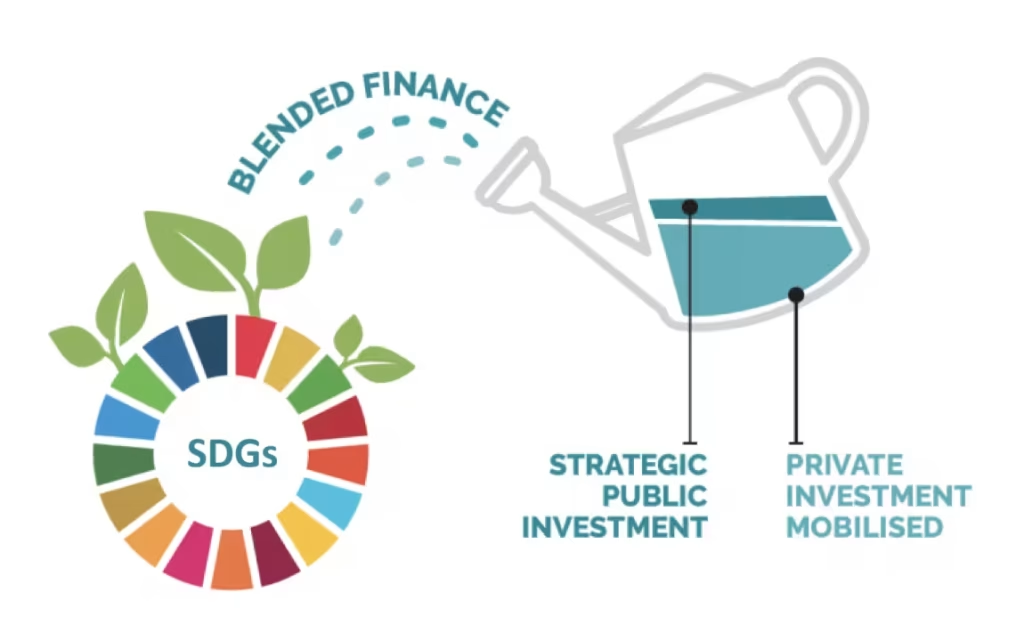
The mechanics of blended finance can vary widely, but the principle remains consistent: it requires structuring deals so that different types of capital work together, each playing to its strengths. Think of it like a financial relay team – each runner has a role, and together, they get the project past the finish line.
Let’s break down exactly how this works.
A. The Capital Stack: Who Takes Risk First?
Every blended finance structure is built on a “capital stack” – a layered arrangement where each type of investor takes on a different level of risk or return.
- Catalytic Capital (Public/Philanthropic Money): This is the first layer and is intentionally structured to absorb more risk. It can appear as:
- First-loss equity (absorbs initial losses)
- Concessional loans (below-market interest rates or longer repayment)
- Guarantees (cover investors if something goes wrong)
- Grants (fund the early work or capacity building)
This layer essentially says to private investors: “We’ll take the early risk so you feel comfortable investing.” It derisks the project and gives confidence.
- Commercial Capital (Private Investors): This is the second layer, where private players come in because the project is now safer and more investable. They contribute through:
- Private equity
- Debt financing
- Bonds
- Institutional capital (banks, pension funds, insurance funds)
These investors expect market-rate returns and rely on the catalytic layer to cushion risks.
B. Risk-Sharing Tools That Make It Work
At the heart of blended finance are risk-sharing mechanisms. Here are the most common:
- First-Loss Capital: Public/philanthropic money covers the first portion of any losses – before private investors are affected. This dramatically reduces perceived risk.
- Guarantees: A guarantee ensures repayment if the project hits trouble. This helps bring in banks and institutional investors who otherwise avoid riskier sectors.
- Insurance Products: Political risk insurance, credit insurance, weather-risk insurance – these protect investors in volatile markets or climate-sensitive projects.
- Concessional Debt: Loans with lower interest rates, longer repayment periods, or grace periods reduce the total cost of the project, making returns more appealing.
- Technical Assistance (TA) Grants: Funding for feasibility studies, training, market research, technology upgrades, and regulatory support. Such assistance boosts the project’s chances of success, indirectly reducing investor risk.
- Interest Rate Buy-Downs: Donor agencies pay part of the interest, so the borrower gets cheaper loans.
- Results-based Financing: Money is released only after certain impact results are verified, improving accountability and reducing misuse.
These tools can be used alone or in combination.
C. The Typical Blended Finance Deal Flow: Step-by-Step
Here’s what usually happens behind the scenes of a blended finance deal:
Step 1: Identifying a high-impact project: Could be renewable power, EV charging networks, sustainable agriculture, water treatment, healthcare access, etc.
Step 2: Assessing the risk and financing gap: Why won’t commercial capital fund this on its own?
What risks need to be mitigated?
Step 3: Public/philanthropic institutions designing the catalytic layer: This could involve:
- Offering a guarantee
- Providing first-loss capital
- Funding early-stage work
- Giving concessional debt
- Setting up a Technical Assistance facility
Step 4: Joining of private investors: Now that the risk is lower, private investors step in for equity or debt.
Step 5: All parties negotiate governance, transparency, and impact metrics: This includes:
- Expected financial returns
- Impact goals (energy access, emission reduction, etc.)
- Monitoring & reporting structures
- Exit strategies
Step 6: Implementation, monitoring, and scaling: The project gets built, monitored, and – if successful – replicated elsewhere.
D. Why This Structure Works So Well
- Public money is used efficiently – Instead of funding the entire project, governments and donors only fund the portion that lowers risk.
- Private investors bring scale – Once derisked, projects attract far larger pools of capital.
- Everyone plays to their strengths –
- Public sector: solves market failures
- Private investors: bring commercial discipline and scale
- Philanthropies: support innovation and capacity building
- It creates a multiplier effect – Every $1 of catalytic capital can mobilize $3–$10 in private capital, depending on the structure.
Key Players in the Ecosystem
Blended finance operates through a diverse ecosystem where different actors play complementary roles:
- Public & Multilateral Institutions – Development finance institutions like the International Finance Corporation, CDC Group, and regional development banks serve as anchor investors and deal architects. They understand both development priorities and investment structuring. Multilateral organizations like the World Bank bring scale, credibility, and the ability to work across borders.
- Impact Investors and Institutional Investors – Pension funds, insurance companies, and asset managers provide the bulk of commercial capital. They seek market-rate returns but are willing to invest in challenging geographies if risks are properly managed.
- Philanthropic Foundations – like Rockefeller Foundation, Gates Foundation, IKEA Foundation – fund the “soft” infrastructure: feasibility studies, technical assistance, and capacity building that make projects viable but don’t generate financial returns.
- Local Governments, NGOs, and Implementing Agencies – set policy frameworks, provide guarantees, and direct public funds toward strategic priorities. They ensure on-ground execution and impact delivery. Meanwhile, private sector companies bring operational expertise, technology, and access to markets.
The magic happens when these actors collaborate effectively. A development bank might structure a deal, a foundation funds project preparation, the government provides a partial guarantee, and commercial investors fill the remaining funding gap. Each stakeholder contributes what they do best.
A Real-World Example of Blended Finance
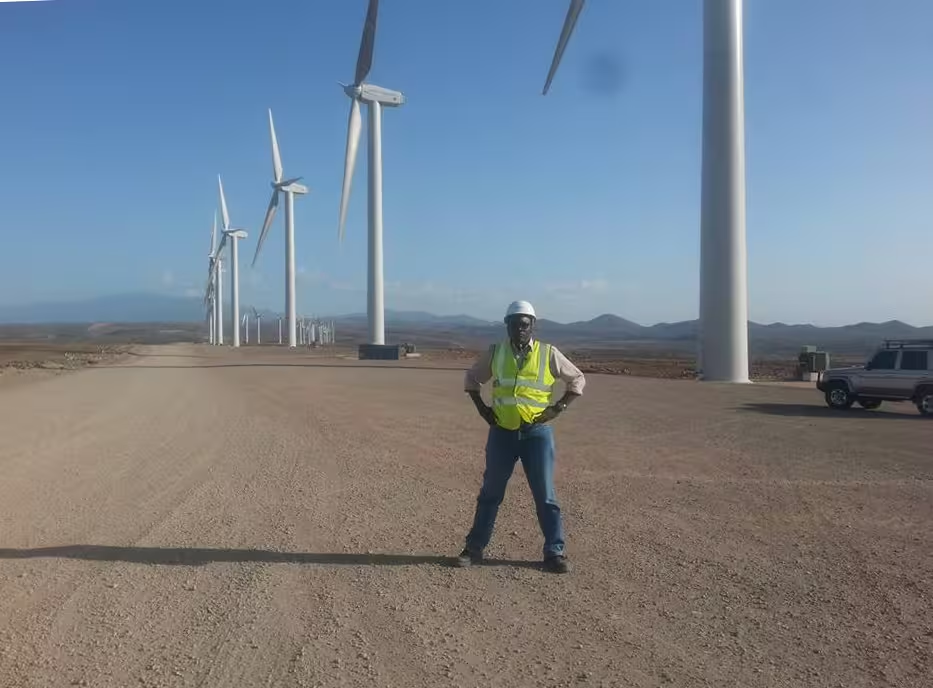
The Project: Lake Turkana Wind Power Project (Kenya)
The Lake Turkana Wind Power (LTWP) Project in Kenya is Africa’s largest wind farm project and one of the best examples of how public, private, and climate-focused capital came together to build a transformative renewable energy asset.
The Problem: Kenya needed more clean, reliable, and affordable power. But LTWP was:
- large (310 MW wind farm)
- to be located in a remote area
- seen as risky by commercial investors
- expensive with long payback periods
- dependent on new transmission lines
- too expensive for the government to fund alone
Hence, traditional investors were hesitant.
The Solution: The project combined private investment, development finance, and public guarantees to de-risk the entire structure.
Capital Stack:
- Private Investors: KP&P Africa; Aldwych International; several impact investors; local Kenyan investors through a consortium
- Development Finance Institutions (DFIs): African Development Bank (AfDB) – anchor financier; European Investment Bank (EIB); Standard Bank; FMO (Dutch Development Bank); Proparco (France); DEG (Germany)
Public/Climate Finance Elements:
- Partial Risk Guarantee from the World Bank to protect investors if the government utility (KPLC) failed to buy the power
- DFIs offered long-tenure, lower-cost loans
- The Government of Kenya invested in associated infrastructure (transmission lines)
- EU/AfDB support for technical assistance and early-stage feasibility
The Outcome:
- 310 MW of clean energy added to Kenya’s grid
- Supplies ~17% of Kenya’s electricity
- Reduced reliance on expensive diesel generation
- Saves millions of tonnes of CO₂
- Became one of the largest private investments in Kenya’s history
- Set a precedent for renewable energy financing in East Africa
That’s blended finance in action. This is one of the most frequently cited success stories in global climate finance – and a textbook example of how catalytic capital unlocks commercial investment for high-impact climate projects.
Where Blended Finance is Making an Impact

Across developing regions, blended finance is channelling capital toward sectors that matter most for sustainable development.
- Renewable energy has emerged as a prime beneficiary. In India, blended finance is helping establish the country’s green bond market, which has been mobilizing big capital for solar and wind projects. In sub-Saharan Africa, similar structures are bringing clean electricity to millions who’ve never had reliable power.
- Infrastructure projects – roads, ports, water systems – have attracted blended finance structures that make long-term, capital-intensive investments feasible in frontier markets. In Senegal, blended financing helped construct a modern toll highway connecting Dakar to its new airport, dramatically improving connectivity while generating returns for investors.
- Healthcare access is another frontier. The Global Financing Facility uses a blended finance model to mobilize public, private, and philanthropic capital for the health of women, children, and adolescents, leveraging every dollar of donor funding to mobilize four dollars in domestic resources and private investment.
- Agricultural development and MSME financing have also seen innovative blended approaches. In Colombia, a blended finance vehicle provided credit guarantees and working capital to smallholder farmers, enabling them to improve quality, access better markets, and increase incomes while delivering modest returns to commercial lenders.
- Climate-Tech innovation & early-stage technologies – battery storage, carbon capture, green hydrogen, EV ecosystem – are high-risk, capital-intensive, and often unproven at scale. EV charging ecosystems in India and Africa are supported by blended capital to build viable early networks before mass adoption.
- Water, Sanitation & Waste Management (WASH) projects have long payback periods, low revenue certainty, regulatory complexity, and often serve low-income communities. Municipal green bonds in India are structured with partial guarantees to finance waste and sanitation projects.
- Affordable housing for low- and middle-income groups often has lower margins, higher repayment risks, and complex land/approval issues. IFC-supported mortgage guarantee programs are improving access to affordable housing finance.
- Climate adaptation and resilience projects – flood defences, early warning systems, resilient agriculture – often don’t generate immediate commercial returns. Coastal resilience projects in vulnerable countries are supported by Green Climate Fund blended facilities.
- Sustainable transportation projects – electric buses, metro expansions, and clean mobility infrastructure – require huge upfront investment and long payback periods. Electric bus financing programs in Latin America and India are backed by multilateral guarantees and concessional lending.
- Conservation, Biodiversity & Nature-Based Solutions are areas where revenue models are still nascent, returns are slow, and risks are pretty high. Nature-based carbon projects are often supported through blended carbon markets, while Blue Economy (oceans) programs are backed by catalytic grants from global NGOs.
Value Proposition of Blended Finance
For developing countries, blended finance offers something increasingly scarce: patient capital at scale. It brings not just money but expertise, technology transfer, and integration into global value chains. Projects financed this way can catalyze broader economic development, creating jobs and building local capacity.
Private investors gain de-risked entry into high-growth markets. Rather than pioneering alone in unfamiliar territory, they invest alongside experienced development partners who understand local contexts.
For donors and development agencies, blended finance multiplies impact. Instead of grants that get spent once, catalytic capital can mobilize five, ten, or even twenty times its value in additional investment.
Society benefits when projects are structured to be sustainable rather than dependent on ongoing subsidies. A solar company that earns returns can expand, hire more people, and serve more customers.
The concept of “additionality” is central here. True blended finance doesn’t just subsidize investments that would have happened anyway. It creates new opportunities, enters markets earlier, or structures deals differently than purely commercial capital would, genuinely expanding the frontier of what’s possible.
Challenges & Criticisms of Blended Finance
Despite its promise, blended finance faces significant challenges and legitimate criticisms.
- High Transaction Costs – Transaction costs remain stubbornly high. Small deals often aren’t worth the effort, creating a bias toward larger transactions that may not serve the poorest communities.
- Complex and Time-consuming Deal Structures – Structuring a blended finance deal requires coordinating multiple stakeholders with different objectives, timelines, and risk appetites. Legal agreements grow complex. Due diligence multiplies.
- Lack of Transparency in Impact Measurement – “Impact washing” concerns are real. Some transactions labelled as blended finance simply provide subsidies to investments that would have proceeded commercially anyway, wasting scarce development resources.
- Potential Misalignment between Public Purpose and Private Profit – The involvement of profit-seeking investors in development work makes some observers uncomfortable. Will the pursuit of returns compromise development objectives? Might investors push for policy changes that benefit them but harm vulnerable populations? These tensions require careful governance and clear safeguards.
- Limited Performance Data – Blended finance at scale is relatively new, and many investments haven’t reached maturity. We lack comprehensive evidence on whether these structures consistently deliver both financial returns and development impact.
- Power Imbalance between International Investors and Local Stakeholders – This can be problematic. Who really makes decisions? Are local voices heard? Does capital flow toward genuine priorities or toward whatever fits investor preferences? These questions deserve ongoing scrutiny.
The Road Ahead for Blended Finance
Despite these challenges, momentum behind blended finance continues to build.
Growth of climate-focused catalytic capital – Annual deal flow has grown substantially over the past decade, with climate finance attracting particularly strong interest, as the climate crisis creates both urgent need and compelling investment cases.
Innovations in structuring blended finance deals are reducing some barriers. Standardized legal documentation cuts transaction costs. Digital platforms help match investors with opportunities. New insurance products address specific risks like political instability or currency volatility more efficiently than bespoke solutions.
Policy developments are creating more favourable environments. Many developing countries have improved regulatory frameworks for private investment. International initiatives like the G20 Compact with Africa aim to systematically apply blended finance principles. The Glasgow Financial Alliance for Net Zero has mobilized commitments from financial institutions to direct capital toward climate solutions, with blended structures often providing the pathway.
Technology is playing a role, too. Blockchain-based platforms are experimenting with fractionalizing investments, potentially allowing smaller tickets and broader participation. Better data and analytics help assess investment risks more accurately.
To achieve the Sustainable Development Goals and meet climate targets, we need to shift trillions in investment toward sustainable development. Blended finance won’t solve this challenge alone, but it’s becoming an increasingly important tool in the arsenal.
Remaining barriers include the need for more standardization, better impact measurement, stronger local financial ecosystems to absorb capital, and continued innovation in addressing frontier risks that still keep commercial capital away from the poorest regions and most vulnerable populations.
Blended finance is neither a silver bullet nor a mere buzzword. It is a practical tool for mobilizing large pools of private capital to address global development and climate challenges. As global development shifts from traditional aid models toward collaborative investment approaches, blended finance stands at the center – offering a promising path where capital aligns with impact, and development becomes more self-sustaining.